
Risk Scenarios Associated with Not Using Prequalification Software
May 27, 2026

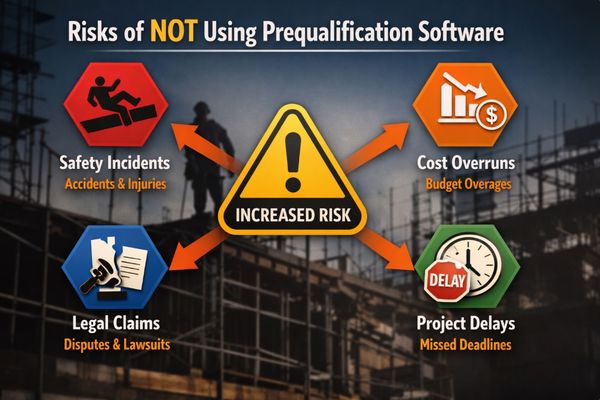
Without a structured prequalification process in place, risk is not just increased, it becomes unpredictable and unmanaged. The issue is less about whether problems will occur, and more about when and how severe they will be. Prequalification software introduces consistency and visibility into the financial stability, safety record, experience, capacity, and overall reliability of a trade partner to help make a more informative decision during the trade partner selection.
Below are some real risk scenarios General Contractors could face when the prequalification process is skipped or handled informally:
Financial Risks
1. Trade Partner Defaults Mid-Project
Without verifying the financial stability of a trade partner, the trade partner can run into cash flow issues mid project and walk off the job before finishing.
Impact:
- Rebid scope at higher cost
- Project delays
- Potential liquidated damages
2. Underbidding Due to Inexperience
An unqualified trade partner can submit the low bid but lacks the operational capability to deliver.
Impact:
- Change orders to recover losses
- Poor quality work requiring rework
- Budget overruns that erode margin
Schedule Risks
3. Inability to Meet Project Schedule
A trade partner who is without adequate manpower or equipment capacity cannot keep up with the project timeline.
Impact:
- Critical path delays
- Trade stacking and inefficiencies
- Missed milestone dates
4. Poor Coordination with Other Trades
An inexperienced trade partner can disrupt sequencing due to lack of coordination experience.
Impact:
- Rework and site congestion
- Reduced productivity across multiple trades
Safety Risks
5. High Incident or Injury Rates
A trade partner with a poor safety record can cause jobsite accidents.
Impact:
- OSHA investigations and fines
- Project shutdowns
- Increased insurance premiums (EMR impact)
6. Lack of Safety Program or Training
No formal safety procedures or training in place.
Impact:
- Higher likelihood of severe incidents
- Liability exposure for the general contractor
Legal and Compliance Risks
7. Lapsed or Inadequate Insurance Coverage
Without verification, a trade partner’s insurance may be expired or insufficient.
Impact:
- Direct liability for damages or injuries
- Costly legal disputes
8. Licensing or Certification Issues
A trade partner who operates without proper licensing or required certifications.
Impact:
- Work stoppages
- Fines and regulatory penalties
- Forced replacement mid-project
Quality Risks
9. Substandard Workmanship
A trade partner who lacks the technical expertise for the scope.
Impact:
- Failed inspections
- Rework costs
- Damage to reputation with owners
10. Inability to Meet Specifications
Materials or installation methods do not meet project requirements.
Impact:
- Warranty issues
- Long-term performance failures
Reputational Risks
11. Owner Dissatisfaction
Project issues caused by poor trade partner performance can have a poor reflection on the General Contractor.
Impact:
- Loss of repeat business
- Negative references
- Reduced competitiveness in future bids
Operational Risks
12. Inconsistent Decision-Making Across Projects
Without a standardized Prequalification process, each project team may vet trade partners differently.
Impact:
- Uneven project outcomes
- Increased risk exposure
13. Lack of Documentation in Disputes
No formal record of trade partner evaluation or approval.
Impact:
- Weaken your legal position in claims
- Difficulty proving due diligence
Strategic Risk (Often Overlooked)
14. Overreliance on Familiar Trade Partners
Without structured evaluation, teams default to “who they know” rather than “who is qualified.”
Impact:
- Missed opportunities to engage better-performing trade partners
- Limited trade partner pool
- Reduced competitiveness
The above risks, either alone or in combination with another, has the potential to result in the General Contractor losing all project profits or, in the worst case scenario, going bankrupt. The use of Prequalification software is no longer an option, it is a necessity!
Recent Posts

Top 12 Reasons General Contractors Choose PreconSuite® Over BuildingConnected®
September 8, 2026

Rick Dill is Featured in This Month’s DCD Magazine
August 20, 2026

How PreconSuite Was Founded: Rick Dill's Mission to Modernize Construction Bidding
August 14, 2026
Business Units: What are They and When Would I Use Them?
June 22, 2026

The Top 4 Reasons Trade Partners Don’t Respond to Bid Invitations
June 9, 2026